
Win, Lose or Draw; It’s How You Play the Game

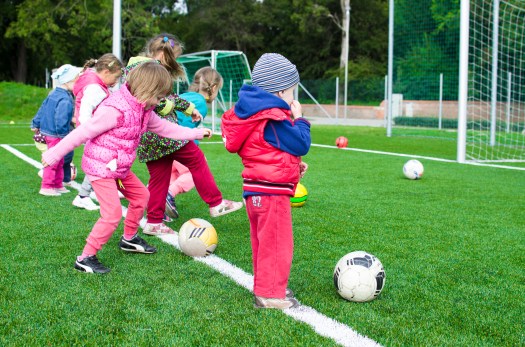
Kids shooting on football stationBY KATHY P. BEHAN

As I watch my son play his first real soccer game, I’m surprised by my competitiveness. I care passionately about my son’s, and his team’s, performance. This is especially astounding in light of the kids’ attitudes toward the game. These 5- and 6-year-olds don’t particularly care what happens. It would be nice to win, but it really isn’t a necessity. These kids are lucky if they know which direction to run in, and which goal to shoot for. They’re just happy to have special T-shirts to wear, and fancy plastic water bottles to drink from during timeouts.

The parents, however, are more difficult to please. Most would love the opportunity to jump into the game and play it “right.” While the kids are busy misguidedly chasing the ball out of bounds, or taking unscheduled breaks by staring up at the sky or lying down in the grass, their mothers and fathers suffer on the sidelines.

Generally, the parents seem to be divided into two different camps — the stoics and the screamers. I’m not sure which is worse. The former, watch their kids kick the ball to an opponent with a horrified look. They watch the action in an embarrassed and painful silence. Then there are the screamers. They yell instructions at their kids while pacing the sidelines, damning the incompetence they’re witnessing and willing their child and his or her team to get it together.

With a tie score and a minute left in the game, the parents of team 4 watch in collective amazement as two of our forwards (5-year-old girls) hold hands while running down the field. They make quite a picture — fingers intertwined, long hair blowing, laughing and giggling while they run. Their involvement is with each other, in the joy of running, and in the beauty of the day — not in the game being played around them.

Fighting my frustration and the urge to scream at them to drop hands and get with it, I have a sudden revelation. This is their game, not mine, and they’re playing it in the wild, careless, spirited manner that characterizes childhood.

From the sport’s standpoint they’re dismal failures; but as human beings, making a potentially stressful situation companionable and fun, they’re to be admired.

Even though I applaud these girls for their joie de vivre, I sure hope they’re not on my son’s team next year.

Kathy P. Behan, a mother of three, is a nationally published freelance writer, specializing in health and family issues.

Surviving the Terrible Twos

mom with baby and young daughterBy Kathy P. Behan

I’ve had it. I just don’t understand why God created two-year-olds. Couldn’t S/HE just work it so one-year-olds go directly to age three? I really don’t think I can hack the terrible twos for much longer — and Taryn only turned 2 seven weeks ago!

The problem essentially is how to get a completely irrational, hyperactive and perverse person (Ms. T) to do anything that I want her to. Sit down (“No!”). Come here (“No!”). Time to eat (“No!”). Time to get dressed (“No!”). See the pattern?

Along with our “cooperation” struggle, I’m also striving to keep her from destroying our house. For instance, she’s magnetically attracted to all fragile and glass objects, particularly the ones that have the most sentimental or monetary value. I’ve “childproofed” our house, so almost all our valuables are at least six feet off the ground (which is another of my complaints. I can’t wait till our house is normal again and everything back where it should be). But when she does manage to get her hands on one, she submits it to a variety of tests. The shake-it-till-it-breaks, the roll-it-on-the-carpet, or what I’ve come to call, the “bounce” test (it doesn’t; but she doesn’t seem even the slightest bit disappointed by this fact).

Taryn also seems to be on a relentless quest to create chaos out of order. She hones in on recently made beds, just put away toys and neatly stacked books. She seems to take it as a personal affront if she’s not allowed to rearrange a neat and tidy room. Speaking of messes, Taryn doesn’t believe in diapers, which is a big problem since she’s not toilet trained yet.

Another area of contention is safety. Not surprisingly, I’m for it and she’s against it. Therefore, I’m saddled with the overwhelming task of trying to keep her from getting hurt. Since she’s a recent graduate of the kamikaze school of toddlerhood, this isn’t easy. She’s not the least bit fazed by the prospect of fire, electric shock or traffic hazards, and seems to enjoy living life on the edge.

I, on the other hand, would much prefer life to be calmer and more orderly. Instead, I spend my day tracking — and trying to contain — my whirling diva of destruction, along with my other responsibilities. Sometimes this combination stretches my limit of frustration.

Take yesterday, for example. Brendan had a half-hour swimming lesson, and “all” I had to do was entertain Taryn. I came equipped, schlepping crayons, coloring books, her favorite picture books and a few toys. Would this keep her occupied? Hardly. She decided to forgo coloring, and the other diversions I had planned for her, in favor of joining the aerobics class that was in session.

After repeatedly hauling her off the exercise floor despite her screaming objections, the swimming lesson mercifully ended. All that was left was to give Brendan a hot shower before heading home. While getting the water ready, I caught a glimpse of Taryn heading into a bathroom stall. She managed to lock the door before I could reach her.

The next sounds struck terror in my heart — the sound of diaper tabs being opened. I spent the next 10 minutes trying to coax this perverse child out of that blasted stall. I never could get her to open it. Poor buck-naked and freshly-cleaned Brendan had to slither under the door and unlock it.

But this wasn’t the end of our ordeal. After re-fastening Taryn’s diaper, and readjusting her pants, I turned my attention to Brendan. In the short time it took to lay out his clothes, Taryn disappeared inside one of the lockers (luckily, this club must be quite familiar with two year olds; the lockers were very well ventilated). The fact that there were easily 200 lockers in the locker room, and that she chose to be quiet for one of the only sustained periods in her life, made finding her no easy feat.

On the plus side, Taryn is awfully cute. And sometimes she actually does listen to me. It’s good to be curious and active. I just hope I’ll be able to make it through the next 45 weeks. That’s how long it’ll be before Taryn turns three.

Kathy P. Behan, a mother of three, is a nationally published freelance writer, specializing in health and family issues.

Dating Dilemma: How Parents Should Respond to Puppy Love

boy and girlBy Kathy P. Behan 

Your daughter comes home from school and utters the phrase that strikes terror in every parent’s heart, “He asked me out!”

Your child is 11, and is no more prepared for dating, than for driving a car. The good news is that the boy is the same age as your daughter, and even though he’s probably a perfectly fine and upstanding young man, you’re not wild about your kid dating anyone. So what’s a parent to do?

For starters, don’t overreact. Take a deep breath, and think before you speak. “If parents overreact they run the risk of communicating something they don’t intend,” believes Sue Blaney, the author of Please Stop the Rollercoaster: How Parents of Teenagers Can Smooth Out the Ride. “They may scare the child, and give them misinformation. Parents should be thoughtful, intentional, and use this situation as an opportunity to ask questions, and have a discussion.”

Plus, you want as much information as possible. If you’re upset, and blurt out threats or commands, it’s a surefire way to get your kid to clam up.

Now that you’re calm, find out exactly what your daughter means. “You need the child to define ‘going out’,” says Marie Sigman, a certified school psychologist, educational consultant and guidance counselor at the Ephraim Curtis Middle School in Sudbury. “Ten to 12 year olds use this simply as a way of saying they like someone. Sometimes they talk about going out, meaning that they want to do things together. Other times it just means talking on the phone or emailing one another.”

In order to have a meaningful discussion, it’s best if parents have familiarized themselves with their child’s adolescent culture. In other words, know the dating scene. What are her friends doing? Are most kids her age going out with boys, or would she be one of the few? If other kids are dating, what are they doing? Are they going out in a group? Are they literally going anywhere, or does it just involve phone and computer talks? Compare notes with other parents about their “dating knowledge” as well.

You can’t make informed decisions in a vacuum. Having this knowledge will help put things in perspective. “You have to know where your kids are, who their friends are, and the culture they’re in, because the culture changes all the time,” says Sigman.

Once you have the “going out” definition down, and you’ve talked to your child about their expectations, now it’s your turn to talk about your feelings, values and most importantly, rules concerning dating.

“It’s appropriate to go to the movies with a whole group of people – that’s perfectly normal for sixth graders,” says Sigman. But going on a date just with a boy should not be permitted.

“You’re trying to delay dating because you’re trying to keep children involved in proper, healthy activities, and to discourage early sexual activity,” says Sigman. “They’re not ready for this. If parents sit back and say, ‘It’s so cute they’re going out,’ really, it’s not cute. The kids are uncomfortable, and don’t know what they’re doing. They’re not emotionally ready for an intimate relationship.”

That concern is echoed by Ann Drouilhet, LICSW, a licensed marriage and family therapist at Family Development Associates in Framingham. “Because they’re a couple, kids think that should dictate moving on to the next level, which is to become physically intimate,” she says. “They may be put in situations that are over their heads.”

At this age, there’s a lot of pressure on kids to date, often from their friends who are trying to set them up. This is especially true for girls. “When a girl finds out that a certain boy likes her, she often feels an obligation to go out with him,” says Drouilhet. “Boys don’t get sucked into that as much.”

Girls also have another disadvantage. “At ages 10 to 12 a girl can lose confidence about who she is as an individual,” says Drouilhet. “She may see dating as an outside reassurance of her worth. Her self-esteem can be tied up with who she’s going out with.”

So besides not being allowed to go out alone with a boy, it’s time to establish other ground rules as well. Be clear and open about your values about dating, relationships and sex. Ask your child why she wants a boyfriend. Talk to her about the difference between love and sex. “Reassure kids that it’s perfectly OK not to be in a relationship at their age,” Drouilhet says. “Tell them that it’s normal to like boys, but they don’t need to date them until they’re older.”

Explain what is allowed: going with a group of friends to a movie, sporting event, or other organized activity. And no matter what they’re doing, make sure there’s plenty of adult supervision. “It’s important for parents to be very clear about their role,” stresses Blaney, “One of their roles is to keep their kids safe. Another, is to be knowledgeable about what is age appropriate, and developmentally appropriate for their child. Parents have to be very comfortable in saying no, as well as saying yes.”

Drouilhet also encourages strong parental involvement when it comes to dating. “Parents have a lot of influence with their child at this age, don’t give it up,” she says. “The mother and father should present a united front on dating, and give their child consistent messages. Parents need to get their opinions out there, don’t shy away from giving kids your input on relationships.”

Dating, growing up, and life are complicated. Parents want their children to be able to deal with whatever comes up. But kids should know that they’re not supposed to have all the answers, and sometimes, you don’t have them either. And that’s OK. Kids just need to know they can come to you for anything, and everything – that you’re always available, and on their side.

Even with the most complete preparation, there’s still bound to be relationship heartbreak. When the inevitable happens, and a young couple breaks up, how should parents handle it?
“Let them express their emotions,” says Sigman. “Remain very calm, and accepting about how sad they are. Once you get beyond that you can discuss how they’re going to deal with school the next day, and what to say to their friends. I’d also ask them what they learned from this. How they might have a different approach next time. Empower them by saying, you know this is probably going to happen again, but you didn’t do anything wrong, relationships just change sometimes. Kids have to feel their own pain – that’
s part of growing up. Just being with them is helpful.”

Sigman also wants to remind parents that middle school is probably the only place where a boy and a girl could start going out together through someone else, never see each other, and break up by the end of the day. So you really can’t take these relationships too seriously.

Even though it may not seem it at the time, there is a silver lining in the breakup storm. The advantage of going through heartbreak in your teenage years is that you become resilient,” says Drouilhet. “You learn when you’re young that you can survive rejection. You can survive disappointment and loss. Those are important life lessons. When you experience this when you’re young, and when the stakes are relatively low, it makes you a more resilient adult. Pain comes with the territory of being a human being, learning how to manage emotional pain will help kids become fully-equipped adults.”

Kathy P. Behan, a mother of three, is a freelance writer specializing in health and family issues. 

People Are Talkin’ At Me

kids & 5 yr old b (2)

My favorite cast of characters.

By Kathy P. Behan

Whenever I’m driving with my kids, the same song plays in my head. You know, the one that goes, “People are talkin’ at me. Can’t hear a word they’re saying…”

For some mysterious reason, whenever my children are placed in a car, their urge to talk is automatically activated. I wouldn’t mind so much, except that they usually like to talk simultaneously, and at high volumes. Plus, all their conversations require some sort of response from me.

Yesterday, for example, we were in our regular middle-of-the-week schlep routine (our motto is: We go almost anywhere, and always at the most inconvenient times!). We hadn’t even pulled out of the driveway yet, when the talk-assault began.

“Mom, who would win a fight between an anaconda and a sand shark?” asked my 5-year-old.

“That’s obvious,” answered the 8-year-old. “But it depends on whether they’re fighting on land or water.”

“On land, and on water,” was the response.

They continued this discussion, while I was mentally searching my memory bank trying to figure out exactly what an anaconda was.

Child No. 3 enters the fray. “Mom, yisten to me. It’s my turn to talk!”

“So Mom, who would win?” queried my nature lover.

“I told you already,” huffed the eldest. “A more interesting question is who’s a better hockey player, Mario LeMieux or Cam Neely?”

“Who cares about hockey! Mom, wouldn’t the anaconda win?”

“Mom, Mom, are you yistening? I wanna talk!” yelled the youngest, kicking the back of my seat.

My response? Why, I did what any normal red-blooded American mother would do — I turned up the radio full-volume. This so thoroughly shocked my kids that they were actually quiet for a good, oh, two minutes.

“Mom that’s too youd!” complained the 2-year-old.

“Yeah Mom, ya wanna make us deaf,” echoed the eldest.

We drove in relative silence, each of the kids temporarily immersed in private reverie.

“So Mom, whaddya think? The anaconda or the sand shark?”

Kathy P. Behan, a mother of three, is a nationally published freelance writer, specializing in health and family issues.
Adventures in Baby-Sitting

new hiking w Stella (4)

The incomparable, Stella.

By Kathy P. Behan

It’s been a while since I’ve taken care of an infant and Reese, my granddaughter, is a bit shy of three-months old. Like all babies her age, her main occupations are eating, sleeping, peeing, pooping and cooing – not necessarily in that order. She, of course, decides what if anything else I can accomplish in a day besides taking care of her. It’s funny to be held captive, and entirely enthralled, by a 12 pound dictator, adorable though she may be.

As I may have mentioned in a previous blog, I’m staying at my son and daughter-in-law’s house for a month, helping out with Reese. At times, this arrangement has been way more complicated than I’d have thought. This is mostly due to Reese’s “siblings” – two cats (one shy, one incredibly rambunctious) and a sweet, beautiful 65-pound mutt named Stella.

Right before I showed up for baby duty, Stella had to have an operation on one of her paws. As a consequence, this active young pup had to be tranquilized for a week so she wouldn’t rip off her bandages and worry her incision. Whenever she needed to “do her business” we had to wrestle her injured paw into a plastic boot (so the stitches wouldn’t get wet) and take her outside on a leash. Then, because the poor thing was drugged, she’d wander around outside, probably trying to figure out why she was there, and maybe, if we were lucky, eventually relieve herself. Inside, if we weren’t attentive enough, she’d shred her bandages, trying to get to her injury and when we really weren’t looking, randomly pee and poop freely about the house. Dog duty almost became as time consuming as baby care.

One of the main reasons I came to baby-sit was to help keep Reese healthy during this horrific flu season. We figured if we kept her in “relative” isolation (pardon the pun), she’d stay well. Sadly, that didn’t go according to plan. Jenny (my daughter-in-law) and I ended up getting colds just days after my arrival. The worst news was we passed our illness along to Reese. Luckily, she recovered much more quickly than we did.

Meanwhile, back on the pet front, Stella soon began feeling like her old hyper-active self. She careened around the house, trying to get us involved in endless games of catch or tug-of-war, and loudly barking at passersby, the mailman and anyone else who had the audacity to show up outside her window. My least favorite of her antics was that she seemed to wait until Reese was right on the verge of sleeping, and then she would casually walk up to the Rumba and stomp on the power button. This would send the LOUD mechanized vacuum into its frantic cleaning mode. Not surprisingly, the commotion of pets scattering out of the machine’s wake and the roar of that bloody device would send Reese from peaceful slumber to wailing wakefulness.

On the whole, even though it’s a bit messy, life is good. It’s easy to overlook the moments of frustration and chaos, when cuddling with a smiling, cooing baby as a sweet pup is sleeping at my feet.

Kathy P. Behan, a mother of three, is a nationally-published freelance writer specializing in family and health issues.