
No Sick Time for Moms

allergy-cold-disease-flu-41284By Kathy P. Behan

I really hate being sick. It’s not just the scratchy throat, runny nose, no energy and queasiness that I abhor. What I object to most is that no matter how sick I am, I still have to do everything I usually do. I just have to do so while feeling spectacularly crummy.

This has got to be one of the worst parts of being a stay-at-home mom. It’s certainly different from the good old days. When I was young and too sick to go to school, my mom would wrap me up in an Indian blanket on a couch in front of the television and serve me ice cold glasses of ginger ale and hot bowls of chicken noodle soup.

The best part was that I’d get a chance to infiltrate her world, watching her bustle around the house cleaning and organizing, and listening to her chat and laugh on the phone. Sometimes we’d watch old movies together and talk about the film’s stars. That’s why being sick was never all that unpleasant. And if I needed anything, all I had to do was ask from the cozy warmth of my nest on the couch.

Now that’s what I call being sick. Even when I had a regular job, I enjoyed sick days. I did have to wait on myself though, because after all I was an adult, and I couldn’t import my mother every time I had a sniffle. I liked staying home from work and luxuriating in my lazy and fevered state. I’d sleep whenever the mood struck, and generally be the perfect patient, drinking juice and lolling around in bed.

Boy, have times changed. Now when I’m sick, life goes on as before. The only difference is that I’m exceptionally slow, crabby and pathetic as I go about my chores and daily routine. I expect everyone around me, especially my children, to be extremely well-behaved, and more importantly, nice to me in my “sick” state.

Oh, in a fantasy world, the kids would be concerned and helpful, cheerfully calling out, “Let me do that for you, Mom, you just rest.” And taking pity on me, they would declare a temporary cease-fire, pledging to get along for my sake.

Obviously reality is much different. I’m staggering around the house looking and feeling as if I’ve been run over by a truck, and yet, I still have to prepare meals, clean house, carpool and play with a house full of kids. When fights break out (and some days it seems as if they run continuously), I can’t even yell because my throat hurts so much that I can’t work up to the proper window-shattering volume that gets their attention.

Tea and sympathy — that doesn’t sound like too much to ask for, does it? Maybe I’ll just lock myself in my bedroom for a few minutes of R&R, or at least until the kids find me.

Kathy P. Behan, a mother of three, is a nationally published freelance writer, specializing in health and family issues.

Teaching kids phone etiquette

pexels-photo-774448By Kathy P. Behan

What is it about kids and the phone? For starters, they’ll come out of nowhere just to interrupt conversations. It’s definitely a conspiracy that they’re all a part of, and it begins at birth. Even new babies are programmed to wake up and fuss just as mom reaches for the phone.

As if their interrupting, fighting, screaming and talking weren’t sufficiently annoying and disruptive, they also literally tried to be part of the call. Back in the day when phones weren’t cordless, my kids would somehow manage to become tied up in the phone line. They would tug at the cord, and twirl it around their bodies until they were wrapped mummy-fashion in the phone’s coils.

This practice, not surprisingly, played havoc not only with my conversations, but also with the phone’s performance. All of our phones eventually developed shorts and loose wires. The result was that each of them would only work if they were placed in a certain position — usually one that only a contortionist would find comfortable.

Besides being more considerate of the family member who’s trying to talk, we’re currently working on other types of phone etiquette as well. For example, instead of snarling “Who is this?” into the receiver, Cullen, our eldest has been told (constantly!) that a simple “Hello” will suffice. But this training is not coming easily. Even when he’s the one making the call, when someone answers, the first words out of his mouth are invariably, “Who is this?”

My four-year-old daughter, though not as overtly rude, has her own telephone quirk. She’ll answer the phone politely enough, but then holds the caller captive. She chatters on endlessly, discussing preschool or the latest episode of Barney. She refuses to get off unless she’s caught, or if the caller is wily enough to trick her into putting one of us on the phone.

Our only reliable telephone child is seven-year-old Brendan. He remains unfailingly polite, accurate and careful in his responses. Unfortunately, as luck would have it, he’s also the one who’s least likely to answer the phone.

Here’s an all too typical scenario in my house: I haven’t seen the kids for what seems like hours, so I think it may be safe to make a call. I quietly reach for the phone and begin dialing. So far, so good, the kids remain out of sight. I begin talking to the “callee” tentatively at first, since I’m not sure how much time I have. Breathing a sigh of relief, I start to relax and enjoy the chat. Soon we begin discussing a more interesting and intimate topic. Suddenly, doors fly open all over the house.

“Mom, I’m hungry. Can I have a snack?”

“Mom, she took my new action figure! Make her give it back.”

“Mom, he called me a name. Is ‘Pooper Scooper’ bad?”

I start out patiently enough. Excusing myself, I remind the kids that I’m on the phone, and they shouldn’t interrupt.

“But I’m hungry, and thirsty, and I can’t reach the glasses.”

“Mom, he hurt my feelings. Make him say he’s sorry.”

“I want my toy back NOW!”

Fighting to maintain my composure, I try for a quick fix. After all, there is still a chance that I can salvage my phone conversation.

“Taryn, give Brendan his action figure. Bren, tell her you’re sorry. Cullen, here’s a glass. Make sure you pick out a healthy snack.”

I again apologize to my friend, and try to resume our talk. Another fight breaks out. After initially trying to ignore it, I finally explode. “Does anyone see that I’m on the phone here! How many times do you need to be told to leave Mom alone when she’s on the phone!”

Even that little outburst isn’t enough to dampen their interrupting enthusiasm. Reluctantly, I tell my friend I’ll call her back at a more convenient time, a.k.a. when the kids are out of the house. I hang up and turn my full attention to the children.

The phone rings. It’s my mother calling long-distance from California. Suddenly, I’m alone in the kitchen.

“Kids, get on the phone. It’s Grammy!”

No answer.

“Grammy’s on the phone.”

No answer.

“Kids, your grandmother wants to talk to you!”

Still no response.

Like I said, it’s a conspiracy…

Kathy P. Behan, a mother of three, is a freelance writer specializing in family and health issues.

Friends Cure Stay-at-Home Blues

hands for mothers & othersBY KATHY P. BEHAN

I was prepared for a lot about motherhood. I knew it would be hard, but very rewarding. I knew that it was a 24-hour-a-day, seven day-a-week occupation, and that it would completely change my life. But there was one aspect of stay at-home motherhood that no one ever talked about, and that took me completely by surprise — how lonely it can be.

After my first child was born, I would get both of us fed, dressed and ready to go. But go where? Most of my friends were either working mothers, or childless career women. I, on the other hand, was held captive by a toothless, charming, demanding and at times, extremely unreasonable little dictator all day — and I thought I’d go out of my mind.

I would sit alone in my house and try to figure out how to fill the hours until my husband came home. I longed for adult conversation. I also desperately needed advice and support for my new lifestyle, and novice parenthood. But most of all, I was very lonely and embarrassed. to admit it, even to myself.

All those feelings came flooding back yesterday, as I talked with a new mother. I was watching my second son’s swimming lesson, and trying to coax my 17-month-old into sitting down for a change. In between chasing my daughter, and watching my son, I struck up a conversation with a young mother. She had just moved to town and was trying to adjust to a new community, a young baby, and stay-at-home motherhood.

I really enjoyed our talk — disjointed though it was by my constantly having to retrieve my little one. I admired this woman because she was off to a really good start. She had just joined a terrific organization called The Family Place (they sponsor weekly playgroups for young children and their mothers), and was checking out the Newcomers and health clubs, and various other places in town where she could meet people. Instead of sitting at home and brooding, she was out on the town, actively trying to plug herself into the community.

As for me, I also had a happy ending — or was it a beginning? After wallowing in misery for a while, I got hooked up with a friend of a friend’s mothers’ group. We met once a week, alternating at each other’s houses. This group was a godsend, and it was something I looked forward to all week. The women were upbeat, fun and honest about the ups and downs of parenthood. I honestly don’t know if I could have made it without them.

Seeing this new mother reminded me that loneliness isn’t something to be ashamed of. It’s only shameful if you don’t do anything about it. Use this emotion as a motivator. Make like a politician, and get out and meet people. Join — or form — a mother’s group. Reconnect with the women in your LaMaze class. “Pick up” nice mothers in the playground. For mothers of older kids, set up a coffee klatch with the moms of children in your youngster’s class.

My friends are one of my strongest support systems. They encourage and help me in so many ways. For starters, they remind me that I have a life apart from my kids. They also keep me sane, reminding me that messing up is as much a part of motherhood as cleaning up. But most importantly, they let me know that I’m not alone, we’re all in this together.

Now, I get by with a little help from my friends — and so can you.

Kathy P. Behan, a mother of three, is a nationally published freelance writer, specializing in health and family issues.

Kids Can Cause Mental Meltdowns

pexels-photo-341378 (1)By Kathy P. Behan

My older sister thinks she’s losing her mind. Though she graduated Phi Beta Kappa from Stanford, she can never remember where she’s put her keys or, at times, even her own telephone number.

After taking her son to a Cub Scout meeting on the wrong night for the second time in a row, one of my friends began to question her sanity. Her husband is also concerned, since she sent him to help out at a school charity event where he found a locked and darkened building.

Even when he called her to confirm the logistics, she insisted that the fair was that day and belligerently told him to remain at the school until they let him in. It’s a good thing he didn’t listen — the event was actually scheduled for the following Sunday.

Whether it’s showing up at the wrong hockey rink at the right time or the right rink on the wrong day or the right day and time but with the wrong kid, the mothers of America are, to put it simply, losing it. The problem is not that we’re all suffering from memory loss, it’s just that we’ve got too much on our minds.

After all, we’re required to remember not only our own busy schedules, but we also have to coordinate our children’s medical appointments, school, athletic and social activities, and for the most part, our husbands’ itineraries as well.

Juggling so many balls at a time, it’s no wonder that occasionally one drops. Just slogging through our daily routines greatly contributes to the clogging of our minds. And as usual, it’s our children who are mostly to blame. After all, they are diabolically gifted at gumming up our mental works. The main reason is because, for the most part, they don’t do what they’re told. If they did, our brains would be free to move on to the next step without having to replay repeated requests.

Here’s what I mean. I’m frantically trying to get the kids up and ready for school, and they aren’t helping. While I’m trying to make lunches, my daughter complains that she can’t find her shoes. I send her off to look for them in the playroom. Brendan wanders by still in his pajamas. Putting the lunches aside, I follow him into his room to remind him that he needs to leave for the bus in 10 minutes and to hurry.

Checking on the progress of my eldest, I discover that he hasn’t brushed his teeth yet and order him to do so. Resuming lunch making, I hear the television in my bedroom. Going to investigate, I discover my still shoeless daughter raptly watching Barney. I turn off the T.V. and remind her to find her shoes.

With T-minus-five until the bus comes, child number two goes into the bathroom still partially clad in his pajamas. Resisting the urge to scream, I urge him to HURRY!

Trying to remember what I was doing, I enter the kitchen and see the still incomplete lunches on the counter. Scrambling to finish, my oldest reminds me that he has a hockey game directly after school and that I need to pick him up. “You’ve got to write my teacher a note, Mom.” I write the note and begin stuffing the lunches into the backpacks.

“I still can’t find my shoes and I’ve looked everywhere!” wails the youngest. After locating the shoes, and tugging them onto her feet, I help Brendan into his jacket. Looking into his backpack, he complains, “This isn’t my lunch box, mine is the blue one.”

Switching the lunches, I then try to quickly usher the kids out the door. On his way, Cullen stops and turns to me. “Boy, Mom, I always thought you had a good memory.” Yeah, so did I.

Kathy P. Behan, a mother of three, is a nationally published freelance writer, specializing in health and family issues.

Dads Who Don’t Deliver

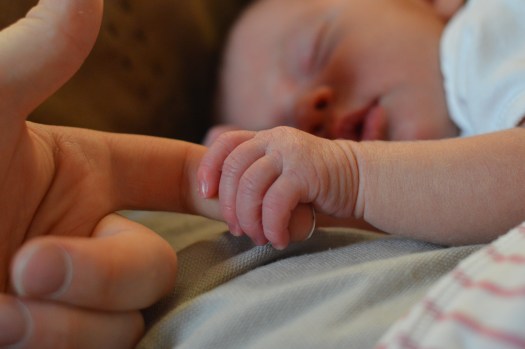
dad holding newborn's hand

By Kathy P. Behan

Until the mid-1970’s, fathers-to-be weren’t allowed in many hospital delivery rooms to witness the birth of their children. Labor was viewed as women’s work and fathers’ jobs consisted of worrying, pacing the hospital’s halls and handing out cigars when it was all over.

But now fathers are not only encouraged to participate in the birth of their children, they’re practically pressured into it. As John, a 28-year-old father-to-be, puts it: “Fathers in the delivery room have become the new ‘in’ thing — everybody’s doing it. I feel as if I have to defend myself for not wanting to be there.”

How popular is the delivering-dads phenomenon? A random, informal sampling of hospitals across the country indicated that 60 to 95 percent of all women giving birth in the past year had husbands or other “support persons” present during labor — even in cases of caesarean sections.

But not all fathers have a desire to witness their child’s birth. Some men simply feel squeamish about the idea. “I’m just not a fan of blood,” explains John.

“It would embarrass some men to be in the delivery room,” says Kermit E. Krantz, M.D., chairman of the department of gynecology and obstetrics at the University of Kansas College of Health Sciences and Hospital. “After all, a man would see his wife in a whole new light. His role as a father, lover and husband is fine, but don’t ask him to become part of the nitty-gritty of having children.”

One of the most common reasons dads give for not being present during birth is a fear of seeing their wives suffer. Reveals Jim, a 37-year-old father of three, “It’s not pleasurable to see someone you love going through such a painful process.”

And it’s not merely being a witness to pain but also not being able to do anything to alleviate that pain. “A father has no control over the situation,” explains Robert Austin, Ph.D., a psychologist in Boston, Mass. “He can’t take the pain away. He’s put in a weak and powerless position, and for some men this is intolerable.”

Explains one father: “I wouldn’t be in any position to help. The only thing I could do is offer encouragement — but encouragement to do what? To bear the pain differently? I think a father’s presence is more of a hindrance than a help. Instead of giving in to the pain and calling out for help or relief, the mother might try to put on a brave
front.”

Other men don’t want to ride the emotional roller coaster of being present in the delivery room. “A father will feel some incredible excitement but also some real panic — getting shaken to the roots,” points out Dr. Austin. “To become part of this process is to let yourself into the fear and terror that a woman goes through.”

Even though the to-be or not-to-be in the delivery room debate continues, all parents must decide for themselves where they stand on this issue. Comments Robert A. Block, M.D., chairman of the department of obstetrics and gynecology, John F. Kennedy Memorial Hospital in Turnersville, N.J., “Today’s parents are a much better informed
population than previous generations. They have a good idea of what they want. And there are enough modes of delivery care available to suit everyone.”

Some hospitals now offer a birthing alternative to a “reluctant” father. He’s allowed to stay with his wife right up until the time of delivery, and then he can retire to a waiting room during the actual birth. After the child is born, the father is immediately allowed to be with his wife and new child.

Kathy P. Behan, a mother of three, is a nationally published freelance writer specializing in family and health issues.